When you begin to get involved with the core healing process, you’ll start by learning how to do emotional release work. Before I address this work, I want to introduce a fundamental principle that underlies your journey into it—that you need to learn to put emotion before story if you wish to meet your emotional system in a hands-on way.
Most negative emotions that we experience are connected to a story in a cause and effect manner that tells how or why the negative emotions have been created. A simple example would be that someone named Bob feels scared because he just had a jolting experience with a rattlesnake where his physical state of wellbeing was threatened. A more nuanced example would be that Bob struggles to engage in a healthy way with women because his mother never patterned healthy relationship for him. Instead, she established a lot of fear within him that he’s never resolved that drives him to struggle with women to this day. In both examples, there’s one or a grouping of negative experiences—the story—that explains why Bob’s experiencing negative emotion, and the behavioral expressions of that emotion.
In some conventional therapies, it’s common to want to connect the dots between your struggles and your stories so you can find an intellectual understanding of how things work. This might seem like a logical approach to problem solving—understand the problem so you can then figure out how to overcome it. But this approach doesn’t work well no matter how much understanding it generates because thinking about, talking about, and analyzing a problem doesn’t actually change things. Only action brings change to issues that have been shaped by action.
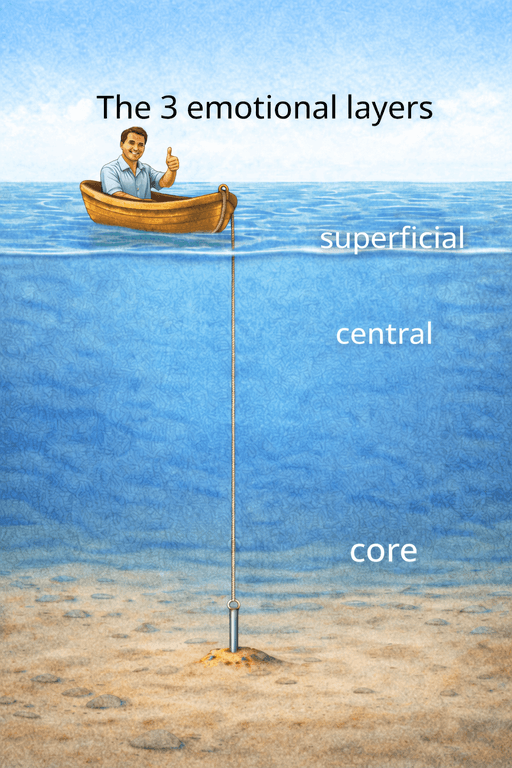
In an earlier post, I explained how emotion is structured into three layers—the superficial, central, and core layers, and when we get torn up emotionally at the central and core layers, that we need to heal to recover from the damage that’s created (03 Neglect and core debilitation). The way this is done is to get hands-on with your emotions instead of staying in your head and thinking about things. The focus of your hands-on work needs to be with the injury itself, not with the story that established or perpetuates your injury.
If you injure your knee, how you got injured is relevant, but if you want to help your knee heal, you don’t focus on the story that has generated the injury. You focus on the injury itself, and you focus on doing whatever’s necessary in a hands-on way to help the injury heal so you can reclaim a state of wholeness and get your knee back. The same is true for emotional injury. You need to get hands-on with your negative emotions so you can help them move through and out of you in healthy ways so you can clear out the waste and give your emotional system the space it needs to rebuild. That’s why you lead with emotion instead of story, and it’s why my clients start their core healing work with emotional release work.
Putting emotion before story doesn’t mean that the stories that are connected to your negative emotions and behaviors are irrelevant. The real issue is about how you get to them, and how you use them once you reach them. When you begin to practice emotional release work, you’ll use stories to access emotion—I’m sad and hurt with my friend Bob, and so I use Bob stories to access sadness so I can do sadness release work. But that use of story is just meant to learn how to meet your system and get things started. As you progress into release work, you’ll find that the deeper you go, the more your system will guide you where you need to go, and it will do this by putting emotion before story.
Let’s say I have a client that has a marriage that’s full of conflict and distance, and he wants my help in changing things. He gets going with his Phase I emotional release work—anger and sadness release work—while I start to give him song. Since he already knows he has a bunch of anger and hurt towards his wife, he uses this knowledge to start to work his way into his core emotions with his release work.

Let’s say it’s easier for him to access his anger, so he puts more time into that. As my client learns to practice anger release work, he’ll find it’s the emotion that he’s learning how to layer through and release that guides the way as he strives to start to clear out all the anger that’s leading him to contribute conflict and distance within the marriage. This will inevitably involve both flushing out old negative emotion within experiences with his wife, as well as other areas of anger related to his relationship, but that aren’t directly connected to his wife. His healing process will direct how this process needs to unfold, and what issues and events and emotion needs to be evacuated. He just needs to learn how to play his part by letting go of a need to control things, and to allow his hands-on work to open up and guide the way.
For example, anger towards his mother might surface along the way, or anger towards old girlfriends. It’s common to have negative emotion and the stories connected to it that clients haven’t thought of for years, or that they never would have linked up to the marriage problem if the process hadn’t done it for them. By learning how to listen to and support the unfolding healing process, it guides the way because it has stored the emotion and the stories within the emotional backlog. So it guides what needs to be released, and in what sequence and depth.
As my client clears out his emotional backlog in this manner, he may need to talk about this unfolding process because it’s pretty amazing and can be quite enlightening. I guide my clients to do this by way of something like journalling or by talking to friends. We end up talking about some of this material in session as well as we work as a team to figure out how to navigate the healing process. Much of this talk should be positive in nature because the dumping of the negative will mostly be dealt with by way of the release work. This type of sharing can be an important way to honor something positive that’s unfolding, but it’s the emotional work that really drives the process and gives my clients the chance to change. That’s why we always lead with emotional work and allow story to come in and play its role as we go.