There are a number of ways to define what it means to be in healthy relationship. There is also plenty of nuance within it where different people and things will share healthy relationship in different ways. But there are some fundamental principles that thread through all types of healthy relationship, and it’s these that I’ll try to focus on with this post.
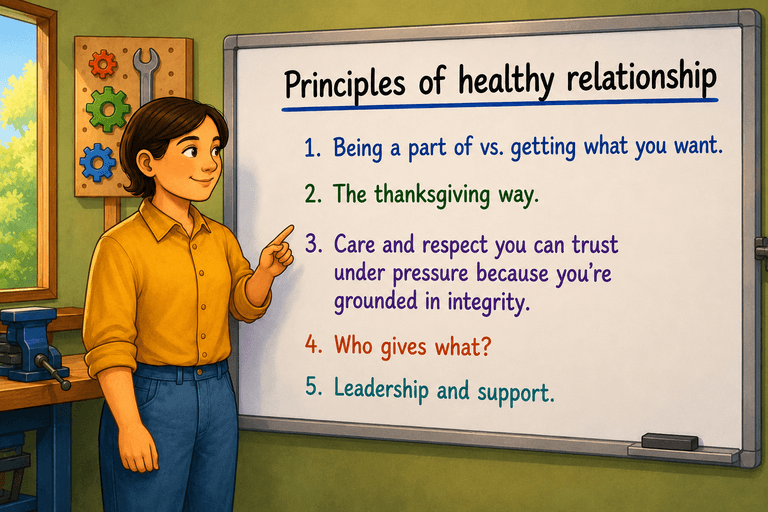
The first principle, which the earth is fully rooted within, is that healthy relationship is about being a part of something, and about giving so you can receive within this experience of union, not just about getting or in taking something from it. That means it’s always about the team, not just about the individuals within it. If you pivot into focusing on what’s best or easiest for you—what works for you, and away from what’s best for the team, then this short-sided view will always weaken the connection and flow within the relationship. And connection and flow is the life blood of any healthy relationship.

A second principle that the earth is deeply grounded in is what I call the thanksgiving way. This position states that life is a gift, the most valuable and precious things that we’re ever given, and it’s not something we own—it’s on loan to us. It states that, when you receive the gift of life, you’ve incurred a type of debt that must be paid off so you can live in balance. The way you pay off your debt is to find and build on the strengths and talents you’ve been given with your life so you can contribute strength and balance to the larger world you’re a part of. In so doing, your life generates contribution, by way of union with your world, that brings more vitality to it. This way of meeting life runs counter to the ‘get more for less’, consumer lifeway that we live in. It focuses on positioning yourself as a part of a whole instead of you at the center of your world.
To understand how giving works within a healthy experience of union, I pivot to our emotional systems to find the next principle. It says we need to be able to share care and respect that’s grounded in things we can trust under pressure because they have the needed integral strength. That’s what a whole and healthy emotional system organically shares as it strives to nurture healthy experiences of union that are grounded in fit. So, if you want trust and respect within a relationship, it’s your job to find and build it so you can share it, especially under pressure. The more you share this successfully, the more your contribution makes a statement to your partner that you need the same in return from him. It’s only through experience with different situations that you can really define what care and respect that you can trust under pressure because it’s grounded in integrity feels like and means.
Once you understand the type of contribution that works well within union, I then pivot to horses for the next principle. For our needs, let’s say there are 3 parts to union—you, the other participant, and the team. The health and wellbeing of the individuals is critical to the health of the team, and the responsibility of finding and maintaining that health depends on who or what is in the relationship. For example, if you have an adult and a baby, then the adult will need to take care of both herself and the baby’s needs to nurture healthy relationship because the baby inherently cannot do much to take care of himself. But, if you have two normal adults, then it’s each person’s responsibility to take care of themselves so they can then have the capacity to give to the greater us. If the relationship is between you and your body, or your emotional system, then you need to learn what these parts of you need so they (and us) can find and maintain wholeness and wellbeing.
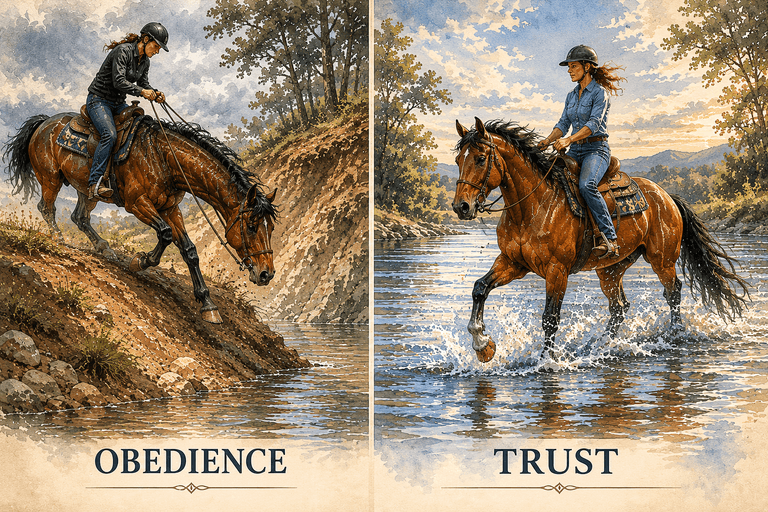
Many horse owners in this culture strive to dominate their horses so they can make them obedient. This control-oriented approach works to a point, but isn’t grounded in what I’d call healthy relationship because it doesn’t give the horse much choice. If you want a partner that’s going to choose you because it trusts and respects you, you can’t dominate it. Ultimately, you need to be so highly skilled as a leader, and to share that skill with your partner so it feels safe enough to give up the reins and trust that, if it allows you to lead, that it will be OK. Because trust for a prey animal means, through it’s eyes, that it’s trusting you with its life, that trust isn’t given easily. You really have to earn it, and then you need to maintain it within every day of your relationship.
The depth of healthy leadership that I strive to share with my horses is intense. I pursue it not only because it opens me to so much connection and flow with them, but also because it shapes me into a deeply balanced leader that I can then share in other parts of my life, such as with my clients. You might think that healthy relationship between adults demands a 50%/50% split in terms of contribution, but that’s not the case for my clients. When my clients seek my expertise, the balance in the beginning of our relationship is usually between 70% to 90% me and 30% to 10% them. That puts a large burden on my shoulders, meaning that I need to be a really balanced and skillful leader if I want my clients to have a chance to accomplish the really difficult task of healing at a core level.

One defining characteristic all of my clients have is a hunger to learn how to contribute to their struggles. My clients come into this work debilitated and usually pretty lost, so they don’t initially have a lot of capacity or skill to share. But, if they’re hungry to learn how to gain these two things, my approach will allow them to heal at a core level, and this will give them what they need to be able to contribute more to our relationship, allowing our ratio to shift towards a more balanced state over time.
My goal as a leader is to meet my clients where they’re at, and then to build from there, usually 5% at a time. If you can start at 15%, OK. Let’s help you heal so you can get to 20% so I can pull back to 80%, and then let’s keep on going, helping you work towards more independence and empowerment so I can step back more and more over time. Eventually, my goal is to transition into a supportive role within our relationship so my clients can lead the way with session and their work until we are able to accomplish their goals and my services are no longer needed.
In the end, all healthy relationship generates independence and fulfillment for its participants. Independence means you can stand on your own two feet and function on your own. Fulfillment, which is something quite different than the pursuit of happiness we espouse in this culture, means you’ve used your experience of union to find satiation. It means you don’t need to keep on chasing after more. It means it’s the journey that’s the focal point and the gift, not just the destination.