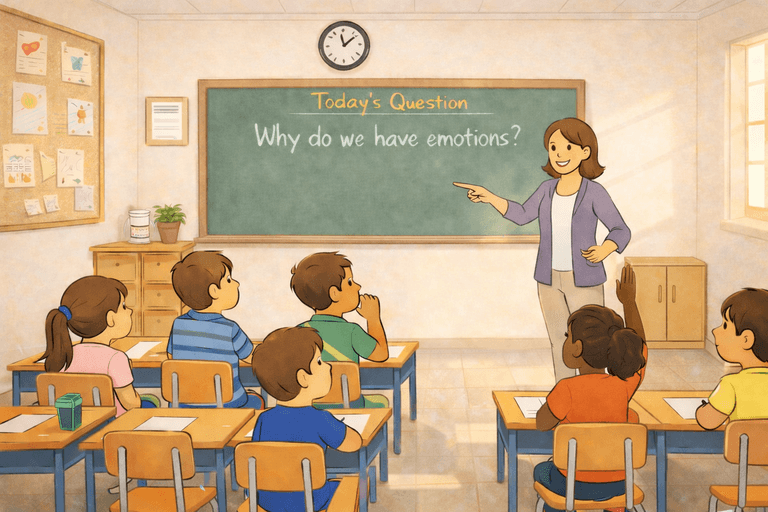
If you want to free yourself from your emotional ignorance, you need to understand, on a functional level, why we have emotions. This will show you how and why you need to learn to engage with your emotional system in a hands-on way so you can do your irreplaceable part to allow this system to function the way it was meant to.
In our culture, we tend to relegate emotions to the position of things that should make us feel good. We understand that we should go out into the world and find things to be a part of so we can feel good emotionally. But when our emotions don’t feel good, we tend to want nothing to do with the negative emotion that gets produced. We try to suppress, ignore, and cover over this emotion so we can get back to the feel good. Because our emotional systems aren’t built to simply make us feel good, this more for less, get as much as you can while giving as little in return approach doesn’t work well.
To understand the functional relevance of emotion, we do have to start with how our emotions feel, but the goal here isn’t to just feel good. It’s to give care to our emotions so they can remain healthy and whole so we can apply them in the world in the same way that you’d use a healthy body to go and climb a mountain.
The key here is to understand that, when our emotional system is awake and alive, or shut down and deadened, our core emotions organically dictate how we act. For example, if you feel safe at a core level, as you step into the world, and especially as you step into challenge, this emotion will direct how you act just as a healthy, strong body will direct how you climb a mountain.
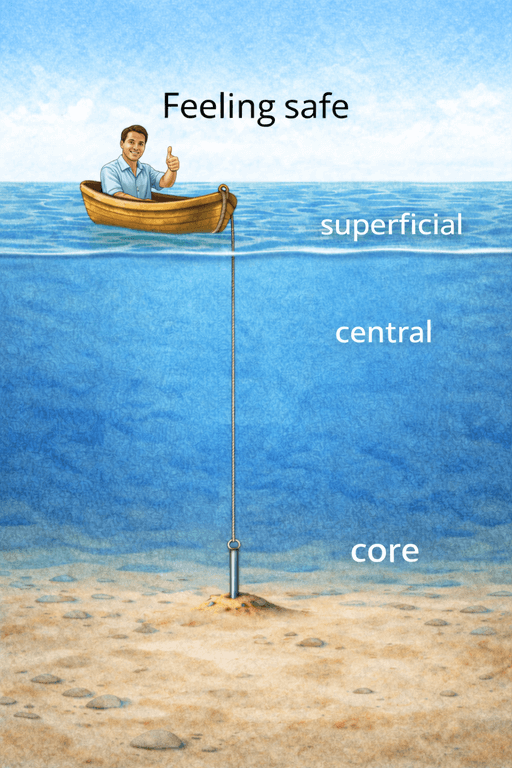
Part of our emotional ignorance infers that emotion is just emotion—for example, you either feel safe, or you feel fear. But the reality is that our emotions have different layers of depth to them. There’s a foundational, core layer, which is rigid and deep, a central layer, which has a more middle road of pliability and depth, and a superficial layer, that shifts and changes easily. All three layers make up how each emotion feels. To be healthy and whole with feeling safe, you need to feel this way at a core level. When you’re not being pressured, your central and superficial layers will follow the core’s lead. All three layers will be awake and alive, and they’ll all feel safe.
Most people in this culture either don’t know how to differentiate how core emotion feels because they’ve (usually unwittingly) learned to suppress and deaden it, or they only know it by way of negative emotional experiences they can’t get away from. For example, when you’re torn up at a core level with the emotion we’re focusing on here, you’ll feel fear and anxiety at a core, foundational level no matter what your circumstances, and this emotion won’t waver unless you’re able to deaden it. Because core emotion runs so deep and is so unbending, it’s meant to be healthy and whole so it can give us a steady, steadfast experience of healthy emotion as we navigate the pressures and challenges of life. The central and superficial layers that sit on top of the foundation are then meant to be more pliable so they can be more emotionally responsive to the pressures we experience.
With feeling safe, we are meant to establish and maintain a core experience of it, and then we need to learn how to step into a world that has hazards so we can learn how to use our emotions to actually be safe. This is possible because of how our different emotional layers respond to pressure. When there’s no pressure on a healthy emotional system, the core emotion dictates how all three layers of emotion feel—in our case, feeling safe. When you step into the world and start getting into potentially hazardous situations, the pressure the presence of hazards generates starts weighing down on your feelings of safety. Since the superficial layer is the most emotionally pliable, it’s the layer that will shift first from feeling safe into a feeling of fear while the deeper, more substantial layers—the central and core layers—are able to hold their own and maintain a feeling of safety.
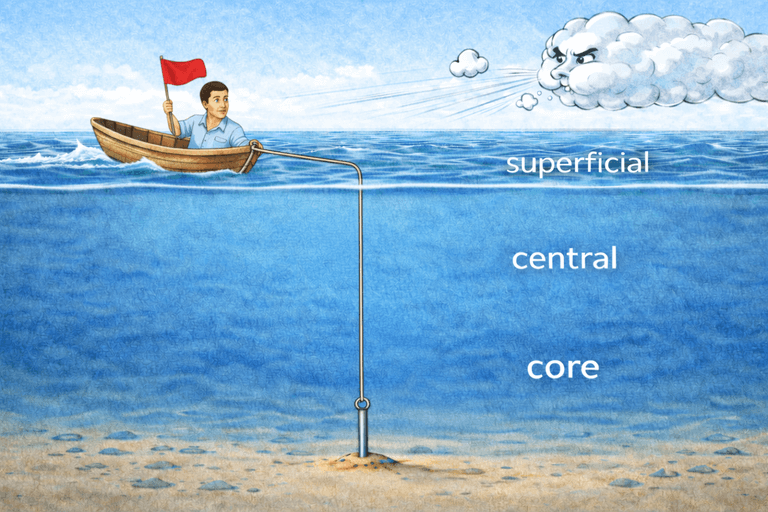
This superficial shift into fear is meant to be a red flag. A warning that something exists in our immediate world that can hurt us. Because this red flag is driven with superficial emotion while the deeper levels are able to maintain their states of feeling safe, this experience doesn’t freak us out and throw us into fight, flight, freeze, or appease mode. It just makes us feel uneasy and drives us to find what’s pressuring us so we can figure out what it is, and how to position ourselves and act upon it so we can stay safe in its presence. In other words, the red flag of superficial fear is meant to create curiosity.
If our curiosity drives us deeper into danger because we’re making poor decisions as we explore the situation, then our emotional system will tell us by sending up an even stronger red flag emotionally as we shift further into fear superficially coupled with a shift into fear at the central layer. This let’s us know that we’re moving in a direction that’s not working. This type of emotion is stronger and deeper than the original red flag of fear.
If we adjust and find the direction that does allow us to be safe, then the pressure coming from the hazard is relieved and we’re able to organically shift back to feeling safe as we figure things out. The pliable superficial emotion organically shifts back to its original position as if it’s being pulled by a bungee cord that’s connected to the core layer. When the central layer shifts into fear, some damage is done, and so it needs to heal once the pressure is relieved so it can organically return to feeling safe. This central layer damage is like getting emotionally bruised. We get beat up, but the damage can be fully resolved with some effort if you know how to give care to it.
If we’re able to use our explorations to learn how to be safe in the face of this hazard, and we’re able to heal through any central layer bruising that might occur, then we will not only return to feeling safe at all levels. We will also have learned how to reinforce this emotion with being safe on the ground. This is the goal of the interaction. This creates an emotional experience that’s grounded in reality, and so is stable and reliable because it has been tested and proven.

A healthy emotional system feels care (warmth, love, and determination) and respect (happiness, kindness, and commitment) that you can trust (feeling safe, hopeful, and courageous) under pressure because it’s grounded in integral strength (feeling worthwhile, good enough, and confident) that’s been tested and proven. When this core emotion is naturally infused within your actions, it drives you towards and into union (feeling welcomed, bonded, and empowered) with the parts of life that fit with the emotional experience that you’re sharing.
Union—finding fulfilling and empowered connection and flow with life—is what our emotional system is meant to help us generate. It’s the primary reason why we have emotions. The more we find it, the more care, respect, trust, and integral strength we fortify within us. When we learn to use this system skillfully, it uses pressure and resonance, not logic and thinking, to help us find our way in life. The intellect can complement what our emotional system is helping us do, but it can’t replace it. This is because the intellect keeps us trapped in our heads where we’re disconnected from life, while the emotional system is meant to handle life directly by way of pressure.
In this culture, we don’t learn to use our emotional systems in this way because we have a flaw in our approach—one that’s grounded in neglect.